


AI Platforms for Patient Access: What They Do, Where They Stop


5 min read
%20(1).png)
A plain definition of the AI platform for patient access, written for CIOs and patient access leaders: the intelligence layer underneath, the AI agents on top, the four jobs one foundation does, and the limits that keep it operational AI and not clinical AI.
Key Takeaways on AI Platforms for Patient Access
· An AI platform for patient access has two layers: a shared intelligence layer underneath and a digital workforce of AI agents on top, both native to the EHR and the contact center.
· Tools bought one at a time share no context, and each brings its own integration and its own copy of the rules. That is why patients still repeat themselves.
· The test for a platform: look at what has changed in the EHR when the call ends. A platform resolves the request. A tool routes it.
· One foundation does four jobs: it resolves patient requests end to end, gives staff the full picture, reaches patients before they call, and connects hospital operators.
· This is operational AI. AI agents book care and route urgency to clinical staff. They never triage, and they replace neither your systems nor your team.
Every vendor selling into health systems now has "AI" on the label, and most CIOs have a patchwork of point solutions to show for it. This article defines what an AI platform for patient access is, what it does, and where its limits are.
What is an AI platform for patient access?
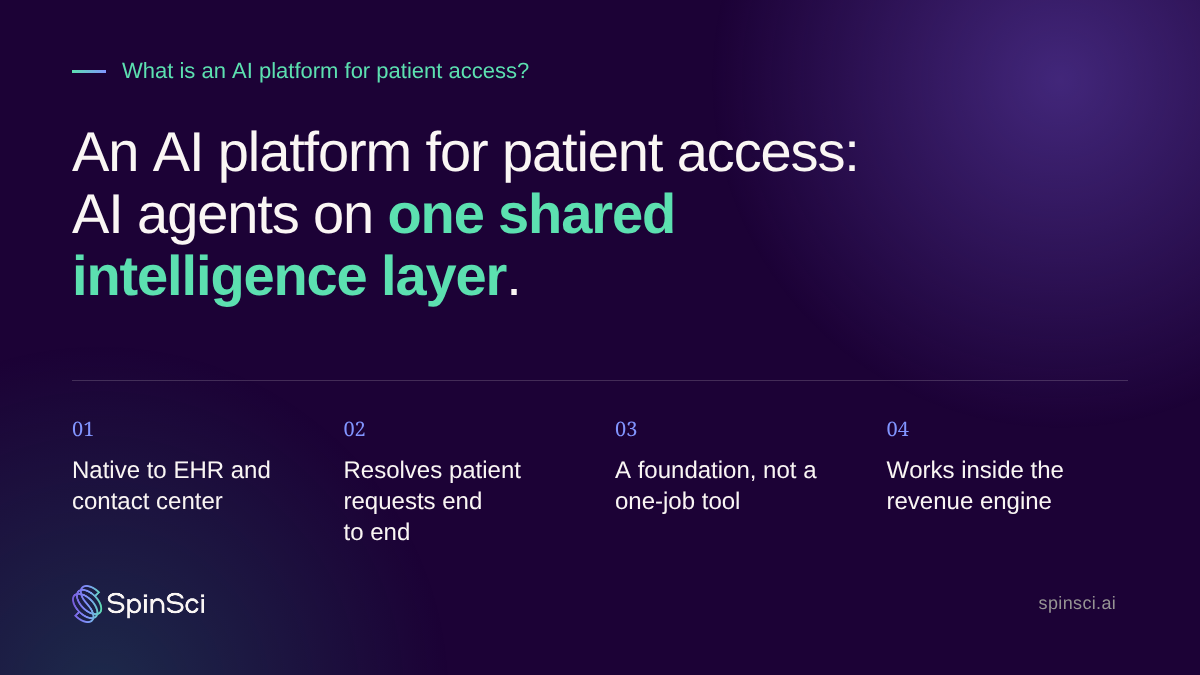
An AI platform for patient access is software that gives a health system a digital workforce of AI agents running on one shared intelligence layer, integrated natively with the EHR and the contact center. The agents resolve scheduling, billing, referral and prescription requests end to end, support staff on calls that need a person, and reach patients before they have to call. It is the foundation that patient access AI runs on.
Two terms sit behind that definition. A platform, in plain software terms, is a foundation other capabilities run on and share. A point solution is a tool built for one job.
Agentic AI is AI that pursues a goal: it plans, decides and acts inside the systems of record, where older tools answer a question and hand the work back. The workers are AI agents, each trained on a specific healthcare workflow.
So the platform has two layers, the intelligence layer underneath and the AI agents on top. It works where appointments are scheduled, referrals converted and bills paid: the revenue engine of the health system.
How is a platform different from a stack of point solutions?
The patchwork did not arrive by design. Every tool in it was bought to solve one problem, by the team that felt that problem most. Each purchase fixed something and left a new gap between tools.
Those gaps are where the cost hides. Each tool needs its own integration to the EHR, and IT maintains every one. Each holds its own copy of the scheduling rules, so one workflow change means rework in several places. And the tools share no context, so the patient who confirmed by text is asked again on the phone.
It is also why so many healthcare AI pilots stall between demo and production. Putting patient access automation on one platform removes the gaps instead of managing them.
The test for a platform: look at what has changed in the EHR when the call ends. Some products route the request to a queue. Some understand it and then route it anyway. A platform resolves it. The appointment is booked, the confirmation is sent, and nobody on staff touched it.
What is the intelligence layer underneath?
An AI agent can act only on what it can reach, and the rules that run patient access are scattered: decision trees inside the EHR, policy documents, tip sheets and spreadsheets outside it, and call context that never leaves the contact center.
The intelligence layer makes that knowledge usable. It takes the decision logic the health system already built and makes it executable by AI, brings in the unstructured documents, and translates static, deterministic logic into the contextual form modern AI needs. Your workflows are not replaced. They become the logic the agents follow.
An agent reasons over four things: the EHR's decision trees, business rules and policies, provider and department preferences, and the patient's context at the moment of the request. Take one away and the agent is guessing.
SpinSci's intelligence layer is the Healthcare AI Fabric (HCAF), purpose-built for patient access and native to the EHR and the contact center. It is the difference between architecture and a wrapper, and its absence is why patient access AI stalls.[C2]
What do AI platforms for patient access do?
They resolve patient requests end to end
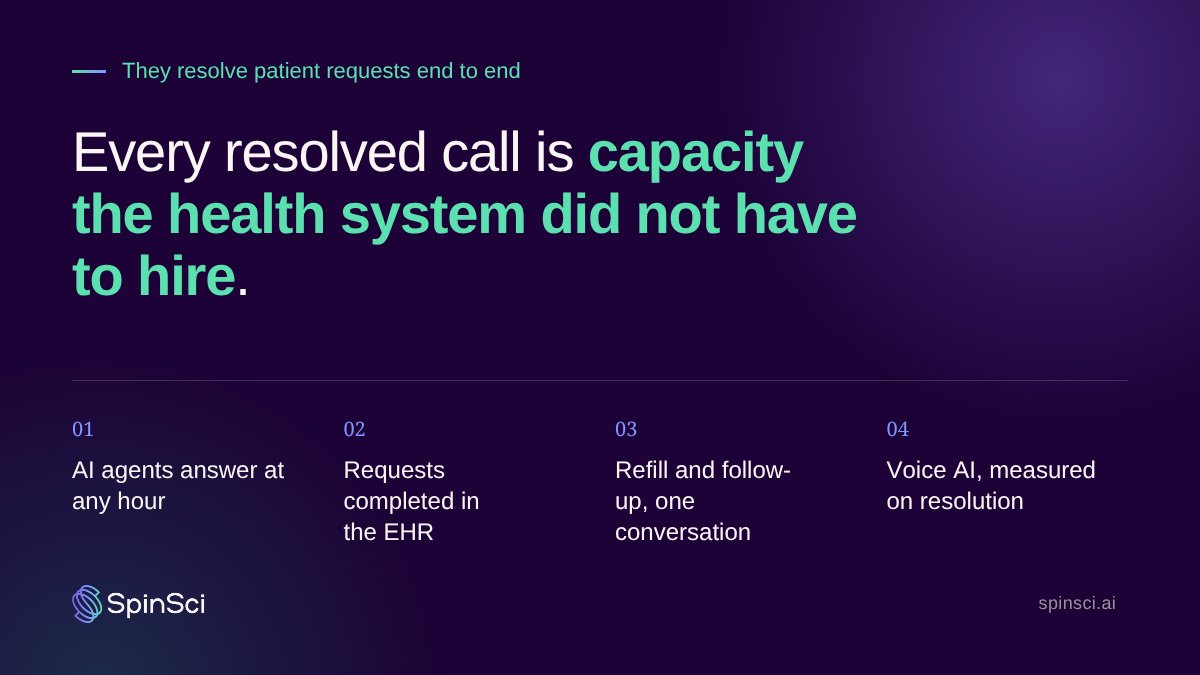
Demand keeps rising, the access team cannot hire fast enough, and volume never falls because patients cannot finish simple tasks without calling and waiting.
On a platform, AI agents answer every call at once, at any hour. They understand the request in the patient's own words, check it against the health system's rules, and complete it in the EHR: the appointment booked, the refill processed, the billing question answered. A refill and a follow-up visit take one conversation.
This is Voice AI, and its measure is resolution. Containment counts only when the task is finished inside the AI. Every resolved call is capacity the health system did not have to hire.
They put the full picture in front of staff
Contact center staff toggle between the EHR, the phone system and other tools to answer one question. The first part of every call goes to finding what should already be on the screen.
With Contact Center AI, the staff member sees who is calling, why, and what has happened so far, in one view, at call arrival. AI agents work alongside the person, surfacing the health system's own rules and the next step as the call unfolds. When an AI agent hands a call over, the context travels with it. Nobody starts over.
Some calls belong with people: clinical questions, distress, complex disputes, any patient who asks for a person. There the platform's job is a shorter handle time and first call resolution, without anyone talking faster.
They reach patients before patients have to call
Referrals leak because nobody closed the loop in time. No-shows waste clinical capacity that was already scarce.
Patient Notification AI works from real EHR events: a referral placed, a refill coming due, a balance outstanding. Outreach goes out by voice, text or email, and it is two-way. The patient confirms, reschedules or completes the task in the same thread, and the result is written back to the record.
A reminder with no reply option becomes one more inbound call. Proactive outreach on the platform runs on the same data and rules as the agents answering the phone, so it closes the loop: fewer no-shows, more referrals converted, more refills completed, more bills paid.
They connect the hospital's own communications
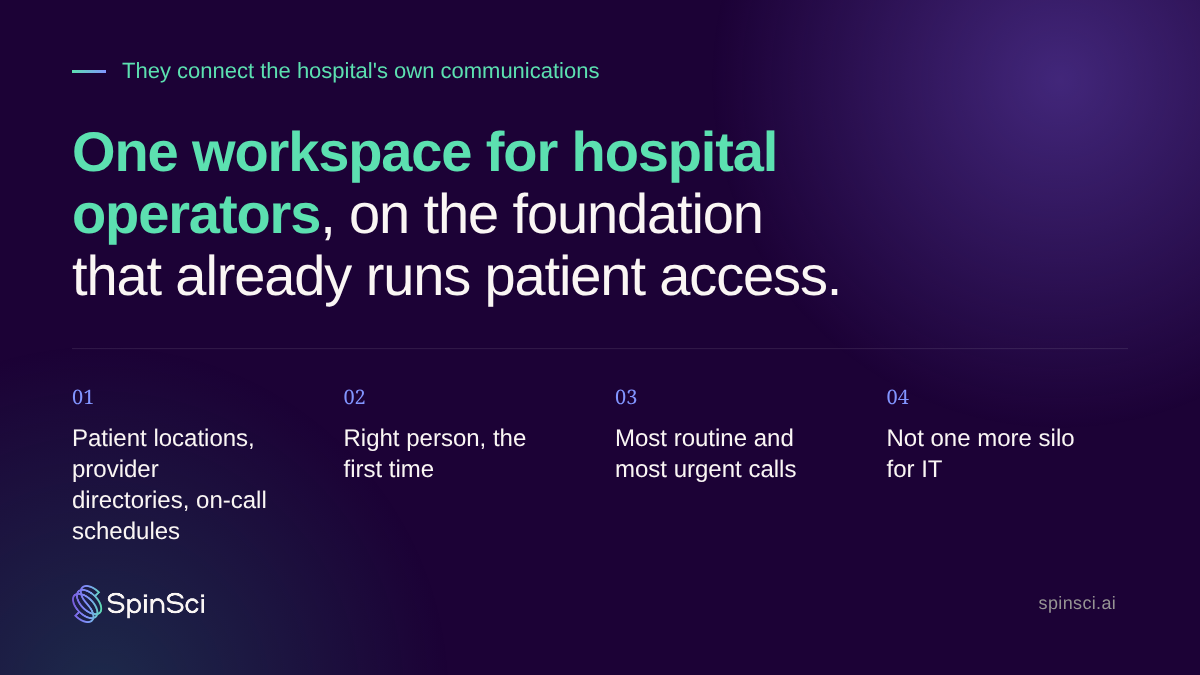
Hospital operators take the most routine calls in the building and the most urgent ones, across several disconnected systems. On the platform they get one workspace with patient locations, provider directories and on-call schedules, so calls reach the right person the first time. This is Clinical Communications: a modern operator console on the foundation that already runs patient access, not one more silo for IT to maintain.
What does an AI platform for patient access not do?
A CIO has to defend this decision on risk, so the limits need the same clarity as the capabilities.
· It does not practice medicine. AI agents book care, process requests and route anything urgent to clinical staff instantly. They never triage, interpret symptoms or give clinical advice, and they offer only what the EHR returns.
· It does not replace the EHR or the contact center platform. It sits on top of both, reads and writes in real time, and makes them AI-ready.
· It does not remove your people. AI agents resolve the routine volume. Staff keep the calls that need judgment, and start each one with full context.
· It does not act off the record. Every action is traceable, access is role-based, and the health system can see what its agents did.
When it is time to compare vendors, SpinSci's buyer's framework for AI patient access platforms covers the evaluation.
See an AI platform for patient access handle a real workflow
Pick one request your team handles every day: a scheduling call, a referral follow-up, a refill. On a short video call, SpinSci shows it handled end to end, from the patient's first sentence to the entry in the EHR, including the handoff to staff with full context. Underneath every step is HCAF, the foundation SpinSci built first. Book a demo.
See how a digital workforce changes patient access at your health system.
%20(49)%20(1).png)
.svg)
%20(48)%20(1).avif)
.svg)