




%20(1).png)
Twenty-four figures on AI agents in healthcare: how fast the market is growing, how many organizations already run AI agents in production, where the return shows up, and what staff expect back. Written for health system leaders deciding where AI agents belong in patient access.
Key AI Agents in Healthcare Statistics
· Agentic AI in healthcare is a provider-led market: valued at USD 1.45 billion in 2025 and projected to reach USD 19.71 billion by 2034, with healthcare providers set to hold a 65.8% share in 2026.
· AI agents are past the pilot stage: 44% of healthcare and life sciences executives say their organizations use them in production, and 46% say their organization plans to put at least 50% of its future AI budget into them.
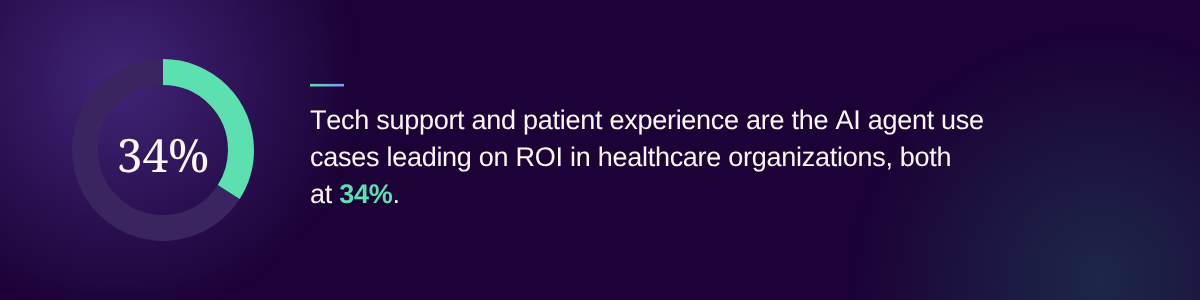
· Patient experience ties for first among AI agent use cases where healthcare executives report ROI, level with tech support at 34%.
· Staff expect real time back: healthcare workers estimate AI agents could reduce administrative burdens by 30% for doctors, 39% for nurses and 28% for administrative staff, and administrative workers predict ten hours saved each week.
· Readiness is the gap: 76% of healthcare professionals expect to learn how to use AI agents on the job, but only 39% feel personally prepared today.
Health systems are under operational pressure from every direction: patient demand keeps rising, costs have to come down, and patient access roles stay open. These AI agents in healthcare statistics show where that pressure is sending the money, what healthcare organizations already have running, and what the workforce expects in return. Sources are listed at the end.
Agentic AI in healthcare is a provider-led market
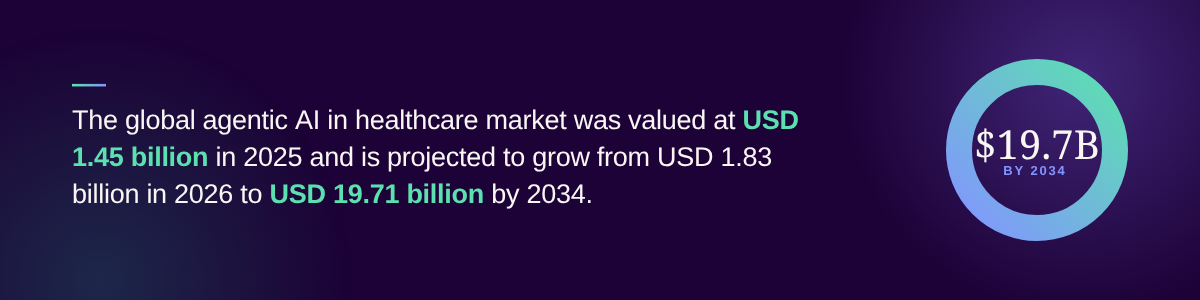
Analysts now size agentic AI in healthcare as a market of its own. A 2026 market forecast shows how fast it is growing and who is buying.
· The global agentic AI in healthcare market was valued at USD 1.45 billion in 2025 and is projected to grow from USD 1.83 billion in 2026 to USD 19.71 billion by 2034, a compound annual growth rate of 34.61% over the 2026 to 2034 forecast period.
· Healthcare providers are the largest buyers of agentic AI in healthcare: the provider segment led the global market in 2025 and is set to hold a 65.8% share in 2026, ahead of healthcare payers and other end users.
· North America is the largest regional market for agentic AI in healthcare, with a 45.52% share of the global market in 2025.
Providers are setting the pace because the pressure on them is operational. The first place to put this spend to work is patient access, where volume is high, the rules are already defined, and every unresolved request costs an appointment, a referral or a payment. That is the work AI agents are built for: they schedule, process refills, answer billing questions and move referrals forward end to end, instead of collecting information and handing the task back to staff.
AI agents are in production, and the budgets are following
For the CIO, the question is no longer whether to try AI agents. It is how many are already running, and how much of the next AI budget they will take.
· 44% of healthcare and life sciences executives surveyed in 2025 say their organizations are actively using AI agents in production, and 34% say they have launched more than 10 AI agents.
· Nearly half (46%) of healthcare and life sciences executives say their organization plans to allocate at least 50% of its future AI budget to AI agents.
· Among healthcare organizations, the most common areas for AI agents are tech support (53%), security operations and cybersecurity (49%), productivity and research (46%) and patient experience (44%). Tech support and patient experience are also the two use cases where healthcare executives most often report a return on AI agents, tied at 34%.
Patient experience sits level with tech support at the top of the ROI list. It is the use case closest to patient access, and patients are ready for it. The return arrives when an AI agent resolves the request, with the appointment booked, the refill processed or the balance paid, not when it answers a question and passes the task to a person.
For organizations still short of production, the model is rarely the obstacle. The obstacle is AI bolted onto data and decision logic that were never made ready for it, which is why patient access AI stalls after the pilot.
Healthcare workers want AI agents, and readiness is the gap
The people carrying the administrative load are not resisting AI agents. They are asking for them, and they are specific about what they expect back.
· In a 2025 survey of 510 US clinicians and medical office administrative staff, respondents estimated that AI agents could reduce administrative burdens by 30% for doctors, 39% for nurses and 28% for administrative staff.
· Healthcare administrative workers predict that using AI agents will save them ten hours each week.
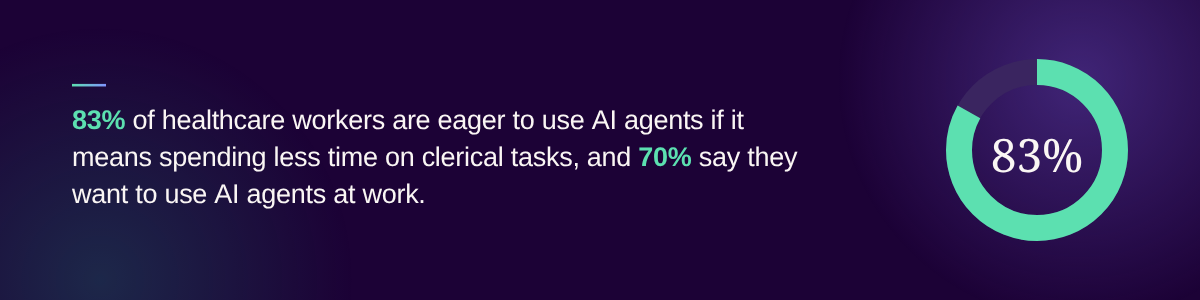
· 83% of healthcare workers are eager to use AI agents if it means spending less time on clerical tasks, and 70% say they want to use AI agents at work.
· Only 38% of healthcare workers recognized the term "AI agents" when first asked, yet once given a definition and use cases, 71% predicted that agentic AI would be essential to healthcare operations within five years.
· 76% of healthcare professionals expect to learn how to use AI agents on the job, but only 39% feel personally prepared to do so today.
The demand is there. The preparation is not, and that is where adoption slows. In patient access, the administrative load is the repetitive call: the reschedule, the refill status, the billing question, the referral follow-up. A digital workforce takes that load two ways. AI agents resolve routine requests on their own, around the clock, and AI agents working alongside staff put full patient context in front of the human agent before the conversation starts.
The goal is not fewer people. It is people spending their day on the interactions that need a person. Readiness follows from how AI agents are introduced: inside the EHR and the contact center platform staff already use, one high-volume workflow at a time, with training as part of the rollout. That is the adoption path covered in this guide to AI agents for CIOs.
See an AI agent resolve a real request
SpinSci gives large health systems a digital workforce of AI agents, built on nearly two decades of healthcare-exclusive focus and running across 165 health systems and 400 million plus patient interactions supported annually. Those agents run on SpinSci's Healthcare AI Fabric (HCAF), which makes EHR data and the unstructured documents workflows depend on AI-ready, and puts the health system's own decision logic behind every agent. The fastest way to judge these numbers against your own operation is a short video call where an AI agent takes a real scheduling request from the first word to a booked appointment in the EHR. Book a demo to see it handled end to end.
Sources:
fortunebusinessinsights.com | cloud.google.com | salesforce.com | spinsci.ai
See how a digital workforce changes patient access at your health system.
%20(48)%20(1).avif)
.svg)
%20(52)%20(1).png)
.svg)