




%20(1).png)
Most patient access AI answers the question, then hands the work back to staff. These eight best practices show health system leaders how to pick the right use cases, run AI agents on your own rules and a live EHR connection, keep oversight built in, and scale only what truly resolves.
Key Takeaways
· Define use cases by volume and risk: sort about ninety days of call data into what AI agents own now, what they take on next and what stays with staff.
· Automate the full pre-visit sequence: if staff finish the booking afterward, it was deflection, not automation.
· Make outreach two-way: EHR-triggered messages let patients confirm, reschedule or pay without calling.
· Give human agents full context: escalations arrive with who is calling, why and what the AI agent already handled.
· Build on your own decision logic: AI agents follow your protocols and read and write to the EHR in real time.
· Design in human oversight: AI agents offer only what the EHR returns and send urgent symptoms straight to clinical staff.
· Build in privacy and compliance from day one: so security review doesn't hold the program back.
· Measure resolution before scaling: track containment rate, transfers, repeat calls and rework, then expand.
Patient access automation only pays off when AI agents finish the task. These eight best practices show how large health systems get there.
1. Define Clear Use Cases by Volume and Risk
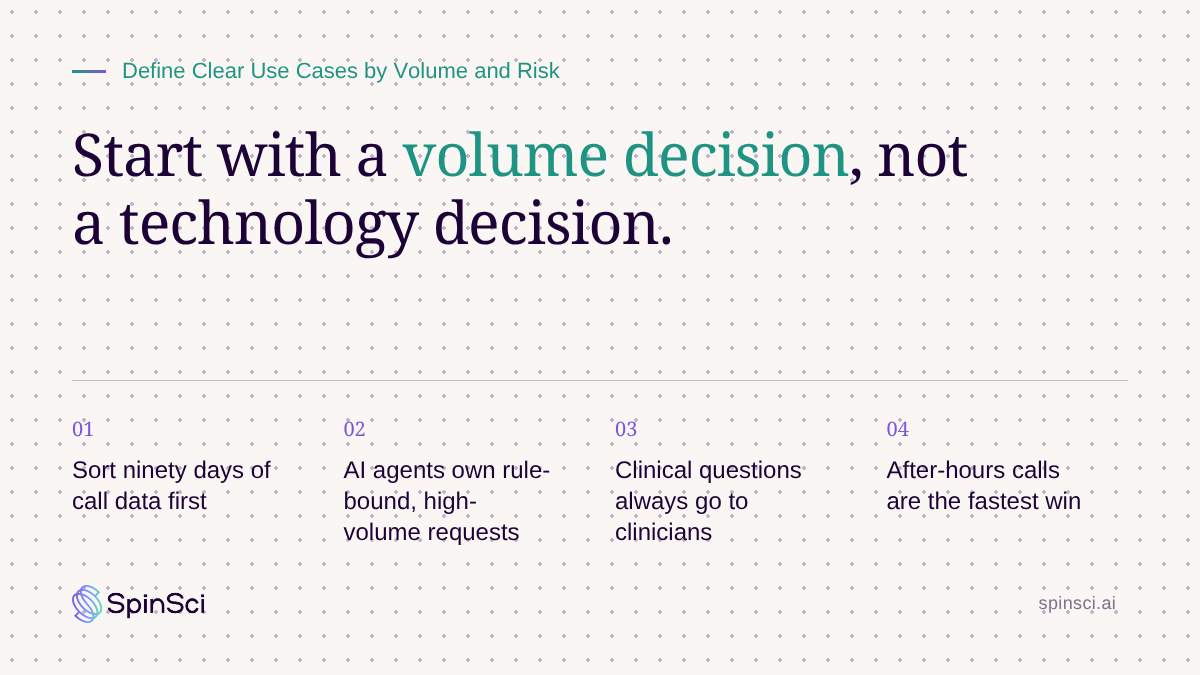
Your access team spends the day on calls that follow the same few patterns, and they crowd out the calls that need a person. Start with a volume decision, not a technology decision: pull roughly ninety days of call data and sort it three ways.
· Own now: high-volume, rule-bound requests with a clear system action: bookings, cancellations that free the slot for backfill, reschedules, confirmations and every after-hours call.
· Take on next: specialty scheduling with referral checks, linked appointments and insurance checks.
· Keep with staff: complex financial disputes and anything else that needs human judgment.
Write the hard boundaries down before launch: clinical questions go to clinicians, urgent symptoms route to clinical staff instantly, and a patient who asks for a person gets one right away. After-hours calls are the fastest win, adding capacity your staffing model never covered.
2. Automate the Full Pre-Visit Sequence, Not a Single Step
Patients call because they cannot finish a simple task any other way. A system that understands the request and then passes the booking to a scheduler has moved the work, not removed it. That is deflection, and it usually ends in a second call.
Automate the sequence instead. The AI agent identifies the patient, matches the reason for the visit to your scheduling protocols and checks the referral and insurance before offering a time. It books in the EHR during the call, confirms, enrolls reminders and collects intake before arrival.
Specialty visits raise the bar. A cardiology consult that needs an echocardiogram is booked as one linked set, because every piece left unbooked becomes a care gap. Referrals are tracked until they become appointments. The patient hangs up with every visit booked, and the callback never happens. SpinSci's scheduling playbook shows what a fully resolved call looks like.
3. Make Outreach Close the Loop Instead of Creating Calls
No-shows waste clinical capacity you already struggle to fill, and a reminder the patient cannot answer rarely prevents one. It creates a second interaction instead, usually a phone call your contact center has to staff.
Trigger outreach from live EHR events, such as a referral placed, a refill coming due or a balance past due, not from batch lists built on stale data. Make every message two-way, so patients confirm, reschedule, pay or ask a question in the same thread. Use the channel they prefer, follow up when the first attempt goes unanswered, and write every response back to the record. The result is fewer no-shows, more referrals converted and less inbound volume. SpinSci's guide to proactive outbound has the full checklist.
4. Give Human Agents Full Context and Real-Time Guidance
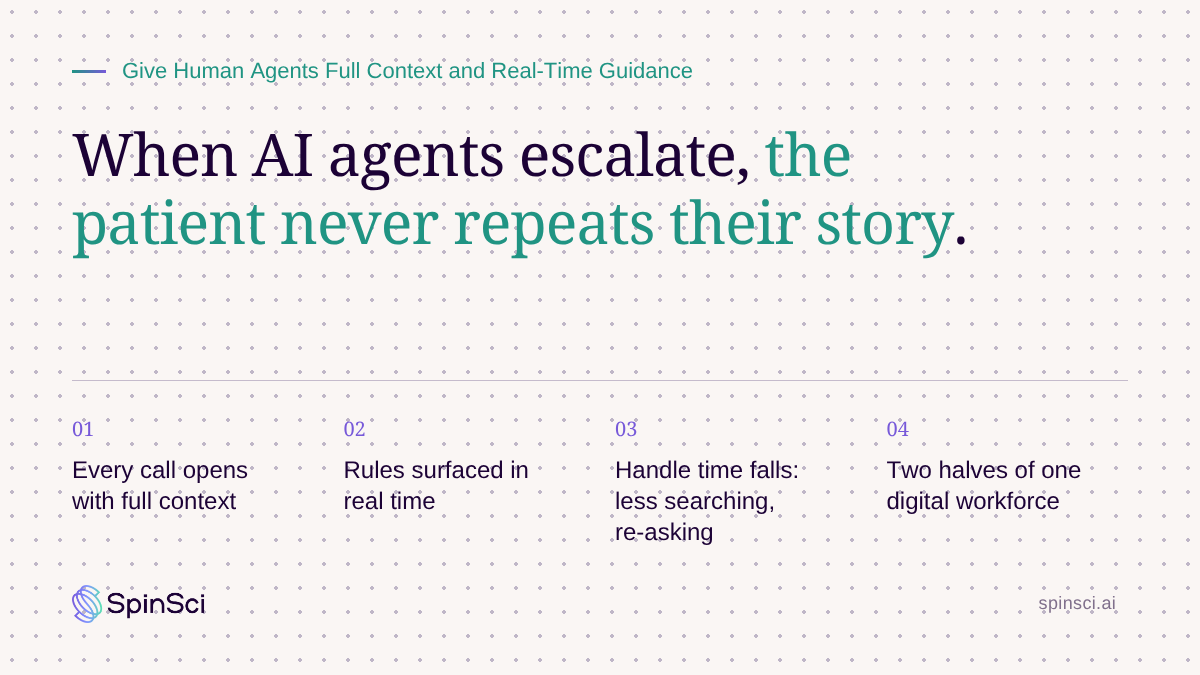
Your staff juggle the EHR, the phone system and a handful of other screens just to answer a single question. Complex and emotional calls still belong with them, and automation should make them faster.
Every call a human agent takes should open with who is calling, why, what the AI agent already handled and what the record shows. When an AI agent escalates, that context travels with the call, so the patient never repeats their story. During the call, AI agents work alongside staff, surfacing your rules and the next step so the booking is right the first time.
Handle time falls where the seconds actually go, in searching and re-asking. AI agents that resolve requests on their own and AI agents that assist staff are two halves of one digital workforce.
5. Build on Your Own Decision Logic and a Live EHR Connection
Hard-coded IVR menus break silently, and broken integrations land in IT's queue. Most automation stalls here, not in the model: generic AI approximates your rules, then books appointments your team has to unwind.
AI agents should run your own decision trees, scheduling protocols and provider preferences, plus the rules kept in spreadsheets, PDFs and tip sheets, and stay current when a workflow changes. The EHR connection must work in real time and in both directions, reading the live schedule and writing the booking back during the interaction. It should run inside the EHR and contact center platform you already have, not as a new silo for IT, and prove itself in your environment rather than a demo sandbox.
That is the job of SpinSci's Healthcare AI Fabric (HCAF), which turns EHR decision logic and unstructured operational data into an AI-ready intelligence layer, integrated natively with the systems health systems already run. SpinSci brings two decades of healthcare-exclusive focus to that work and serves 165 health systems.
6. Maintain Human Oversight With Guardrails Built Into the Design
Once the foundation is right, trust is the next gate: an AI agent no one can audit never makes it past the pilot. Oversight does not mean a person approves every action. AI agents act on their own inside boundaries you set, and people own the exceptions.
Build clinical guardrails into the architecture, not into settings someone can switch off. AI agents offer only what the EHR returns, so they never invent an open slot. Urgent symptoms bypass scheduling and go straight to clinical staff. AI agents book care and never give clinical advice.
Set confidence thresholds that trigger escalation, give every handoff a clear owner, and keep every action traceable through audit trails. Review rule changes before they go live, and review escalations and staff corrections regularly to catch errors early. That visibility is what earns the sign-off to expand.
7. Build Privacy, Security and Compliance In From Day One
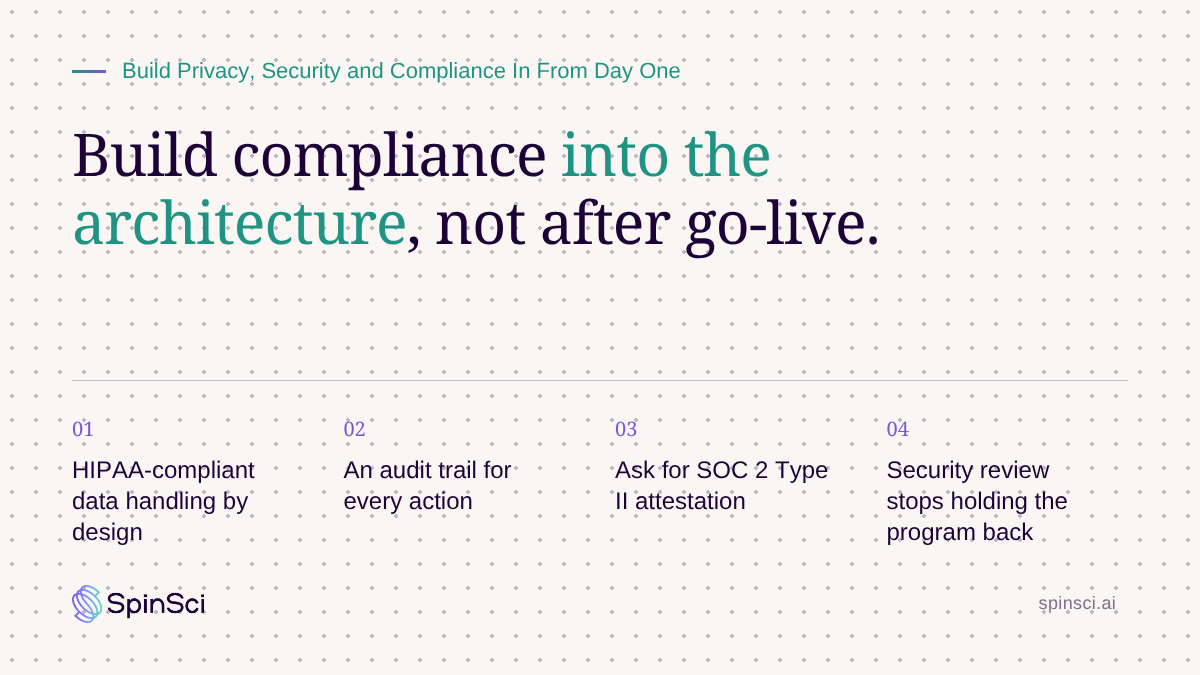
AI agents handle protected health information on every interaction, and the security review is where many rollouts stall. Treat compliance as part of the architecture, not a policy added after go-live.
Require HIPAA-compliant data handling by design, role-based access tied to your enterprise identity system, secure handling of call recordings and transcripts, and an audit trail for every action. Ask for independent security attestation such as SOC 2 Type II. When those answers are ready on day one, security review stops being the step that holds the program back.
8. Measure Resolution, Not Deflection, and Scale in Phases
Board pressure for AI results tempts teams to report whichever number looks best, and a deflection rate can look strong while the work stays undone. Agree the metrics before the pilot starts: containment rate (calls resolved end to end inside the AI), transfer rate, repeat calls and rework, meaning how often staff correct what an AI agent booked. Read handle time alongside first-call resolution, never as a quota for individual staff members. Metrics tied to a clear mechanism carry a program past the pilot.
Then scale in phases, by service line and channel, on one foundation; every added point solution brings another integration and another data silo. Bring frontline staff in early, tell them what the AI agents will and will not handle, and give them a way to flag a bad outcome. The goal is capacity for a team you cannot grow, not a headcount cut.
See a Patient Access Workflow Resolved End to End
Book a short video call to watch a SpinSci AI agent take a scheduling request, check the referral, book the appointment in the EHR and hand off to a person with full context when one is needed. Book a demo to see what resolution looks like in practice.
See how a digital workforce changes patient access at your health system.
%20(49)%20(1).png)
.svg)
%20(48)%20(1).avif)
%20(23)%20(1).avif)
.svg)