




%20(1).avif)
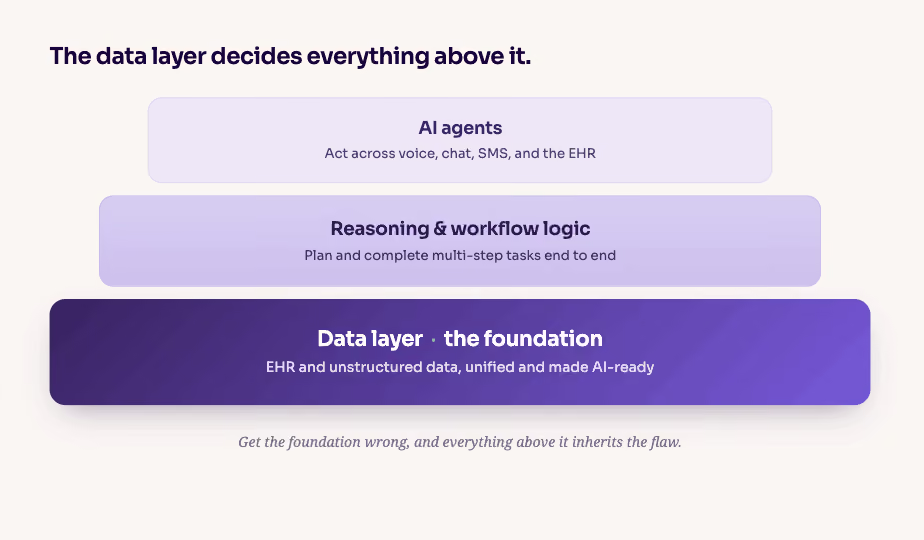
Healthcare AI fails without data readiness because an AI agent can only act on data it can reach, understand, and trust. Clinical records sit in the EHR, operational rules live in people’s heads, and most context is unstructured. Until that data is unified and made AI-ready, even a strong model cannot finish a workflow.
Most healthcare AI does not fail because the model is weak. It fails because the data underneath it was never ready. Health systems buy AI to fix patient access, then watch it stall the moment it meets a real workflow. The model can hold a conversation, but it cannot finish the task, because the information it needs to act is scattered, incomplete, or locked in systems it cannot reach. The problem is not the intelligence. It is the foundation that intelligence runs on.
Why Do Healthcare AI Projects Keep Failing?
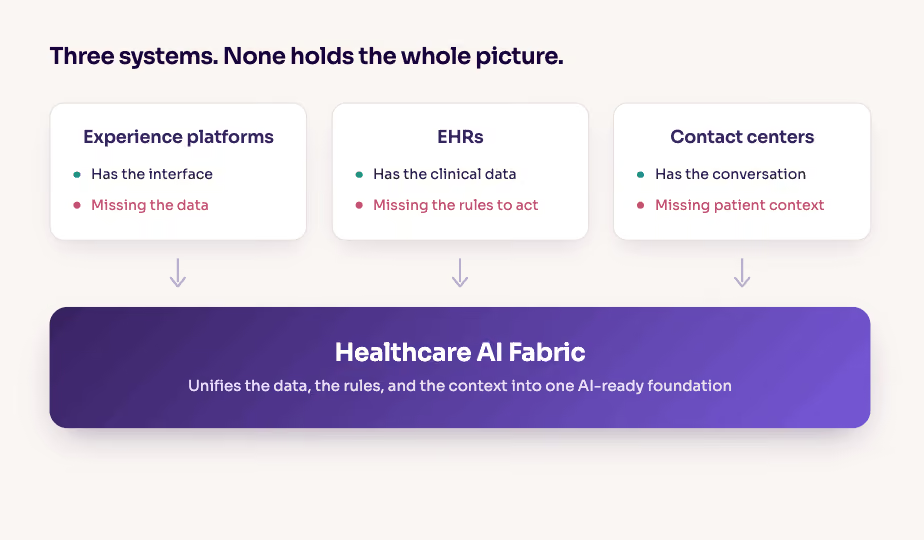
They break at the jump from a clean pilot to messy production. In a pilot, the data is hand-picked and tidy. In production, it is fragmented across EHR systems, stored in a dozen formats, and full of gaps no demo ever shows. The numbers bear this out. Cisco’s AI Readiness Index found that 97% of health leaders call AI essential, but only 14% are ready to deploy it. Bessemer reports that just 30% of healthcare AI pilots reach production. The reason is almost always the same: the data an agent needs is split across three systems, and none holds all of it. Experience platforms own the interface but not the data. EHRs hold the clinical data but not the rules to act on it. Contact centers carry the conversation but not the patient context.
What Does Data Readiness Actually Mean?
Data readiness means information that is unified, cleaned, and structured so an AI agent can reason over it and act. It is not a data warehouse, and it is not a dashboard. It is a working foundation that pulls together everything an agent needs to make a decision and complete a task.
Most health systems already own the raw material. The large majority of it is unstructured, sitting in provider notes, PDFs, scanned documents, and scheduling instructions buried in email, and most legacy systems cannot touch it. A lot of healthcareAI fails right here, because the data feeding it is messy, inconsistent, and never prepared for AI reasoning. Getting to readiness means combining that unstructured information with the structured EHR data around it and translating the whole into something a model can actually reason over.
Why Clean Clinical Data Still Is Not Enough
Even spotless clinical data does not tell an agent how your health system actually runs. The EHR knows the patient. It does not know that a specific provider will not take new patients on Mondays, that a certain visit type needs a longer slot, or that a referral has to clear three departmental rules before it can be booked. That operational logic is the missing layer. It is the difference between an agent that knows a patient needs an appointment and one that can schedule the right appointment, with the right provider, under the right rules.
This gap has a cost. S&P Global reports that 84% of healthcare organizations believe data mismatches already contribute to lost revenue. Closing it means building your real decision logic into the foundation, so the agent behaves like a trained staff member who knows the rules, not a generic bot guessing at them.
What Can AI Agents Do Once the Data Is Ready?
Once the foundation is right, AI agents stop answering and start doing. That is the line between a chatbot and an AI agent. A chatbot responds. An agent completes the work. With a real data layer underneath them, agents can:
• Schedule, reschedule, and cancel under your own rules
• Turn a referral into a booked visit, with no handoff
• Resolve billing questions and prescription refills endto end
• Escalate to a human with full context already attached
Do that across enough workflows and you have a digital workforce: agents that absorb theroutine volume and give your team capacity back for the cases that genuinely need a person.
How Should You Evaluate an AI Vendor?
Do not ask what the model can do. Ask what happens to your data before the model ever sees it. The answer separates a real platform from a thin layer of AI bolted onto someone else’s stack.
• Does it unify structured EHR data with unstructured information?
• Does it encode your workflow rules, or just read records?
• How deep does it integrate with your EHR and contact center?
• Will an agent finish a workflow, or hand it back to staff?
The winners will not be the ones with the flashiest model. They will be the ones that treated data readiness as the foundation, not an afterthought.
What Is the Healthcare AI Fabric?
SpinSci’s Healthcare AI Fabric is that foundation. It unifies clinical data, operational logic, and patient context into an AI-ready layer, integrated natively with the EHR and contact center systems you already run. Nearly two decades of healthcare-only focus, across 165 health systems, is the ground a real digital workforce stands on.
To learn more, read What is Patient Access AI: A Guide for Health Systems.
See how a digital workforce changes patient access at your health system.
.svg)
%20(30)%20(1).avif)
.svg)