


AI Patient Appointment Scheduling Statistics


5 min read
%20(1).png)
Eleven statistics on AI for patient scheduling, from a market projected to reach USD 555.09 million by 2033 to a 50.7% cut in missed appointments, with what each one means for patient access leaders at large health systems.
Key Takeaways
· Valued at an estimated USD 63.04 million in 2024, the global AI in patient scheduling software market is expected to reach USD 555.09 million by 2033, a CAGR of 27.64% from 2025 to 2033, and North America held the largest revenue share at 47.70%.
· Hospitals led the market by end use with a 44.91% revenue share, outpatient scheduling led by scheduling type with 42.81%, and clinics are anticipated to grow at the fastest CAGR from 2025 to 2033.
· Cloud-based deployment led with an 84.23% revenue share and on-premises deployment is expected to post a significant CAGR from 2025 to 2033, but results depend more on whether the AI agent reads and writes the EHR during the call than on where it is hosted.
· Scheduling automation adoption is linked to a 20% reduction in administrative overhead and a 15% decrease in patient no-show rates.
· AI-driven no-show prediction cut missed appointments by 50.7% and average patient wait times by 5.7 minutes, a case for outreach shaped by each patient's history instead of one reminder for everyone.
Demand for appointments keeps climbing faster than scheduling teams can hire, and every request that goes unanswered or slot that sits empty is capacity the health system already has and never uses. These AI patient appointment scheduling statistics show how fast the market is growing, where adoption is concentrated, how the software is deployed, and what automation does to overhead and missed appointments.
The market is growing fast, and North America leads it
Health system boards want AI results they can measure, and spending on AI for scheduling is growing quickly.
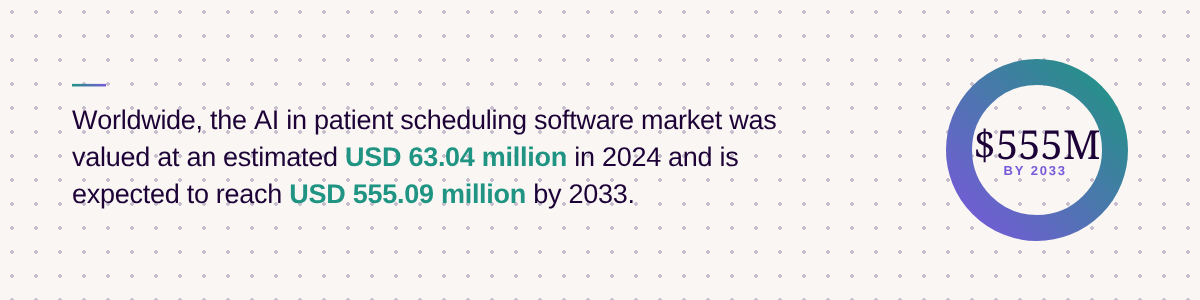
· Worldwide, the AI in patient scheduling software market was valued at an estimated USD 63.04 million in 2024 and is expected to reach USD 555.09 million by 2033, expanding at a CAGR of 27.64% from 2025 to 2033, according to one market forecast.
· North America held the largest revenue share of the AI in patient scheduling software market, at 47.70%.
Growth brings more products that promise to schedule, and many of them stop at finding an open slot. The ones that pay back run the health system's own scheduling rules, check the referral and book the appointment in the EHR before the patient hangs up. Tools that stop short of booking hand the work back to staff, which is why many pilots fail to scale. Our Voice AI for Scheduling playbook sets out the standard.
Hospitals and outpatient scheduling hold the largest shares
The same forecast shows where that spending sits.
· Among scheduling types, outpatient scheduling led the AI in patient scheduling software market, taking the largest revenue share at 42.81%.
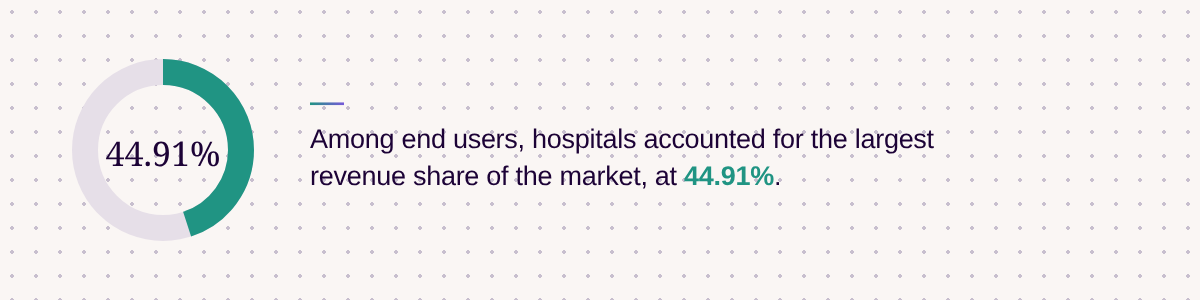
· Among end users, hospitals accounted for the largest revenue share of the market, at 44.91%.
· The clinics segment is projected to record the fastest CAGR from 2025 to 2033, driven by growing demand from small and medium-sized healthcare settings for efficient appointment management.
Hospital and outpatient schedules are also where each booking carries the most rules: visit types, provider preferences, referral checks, and specialty visits that need linked appointments booked in the right order. An AI agent has to work through every one of those rules during the call. If it cannot, the booking lands back on a scheduler's desk and the patient waits for a callback.
Cloud leads deployment, but the EHR connection decides the result
On deployment, the split is lopsided.
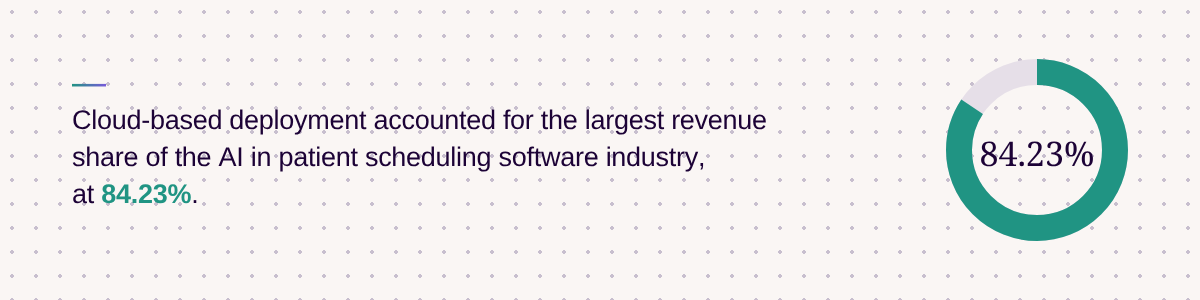
· Cloud-based deployment accounted for the largest revenue share of the AI in patient scheduling software market, at 84.23%.
· On-premises deployment is expected to post a significant CAGR from 2025 to 2033.
Where the software runs matters less than what it can reach. An AI agent that cannot read the live schedule, the referral and the health system's rules, then write the booking back to the EHR during the call, leaves the work for staff however it is hosted, and adds one more disconnected tool to the stack. SpinSci's Healthcare AI Fabric (HCAF) is built for that job: the intelligence layer under every SpinSci AI agent, integrated natively with the EHR and the contact center systems health systems already run.
Scheduling automation is linked to lower overhead and fewer no-shows
Your schedulers spend the day booking, confirming and rescheduling by phone, and the empty slots still come.
· Scheduling automation adoption is linked to a 20% reduction in administrative overhead, according to one industry analysis.
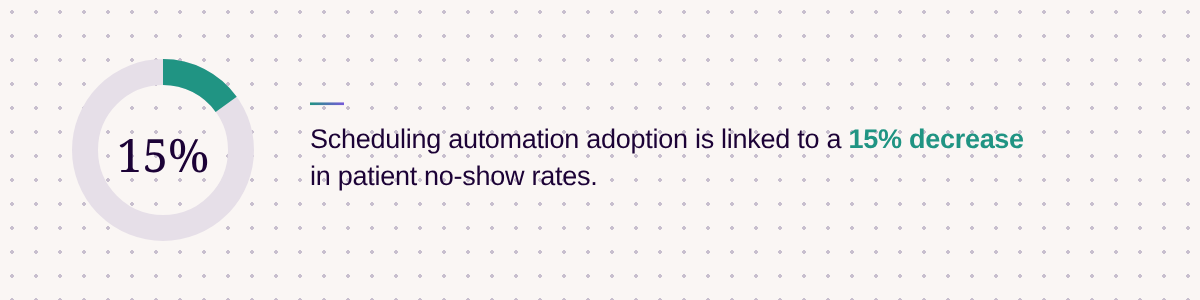
· Scheduling automation adoption is linked to a 15% decrease in patient no-show rates.
In scheduling, the overhead lives in routine phone work and in reminders patients cannot answer, which turn into more calls. AI agents take that work on. They book, confirm and reschedule in the EHR, and their reminders are two-way, so a patient confirms or moves the appointment in the same text thread instead of calling in. Our guide to patient outreach automation shows how that frees the team for the calls that need a person.
No-show prediction puts outreach where the risk is
Every missed appointment is clinical capacity that was scarce to begin with, and it cannot be recovered.
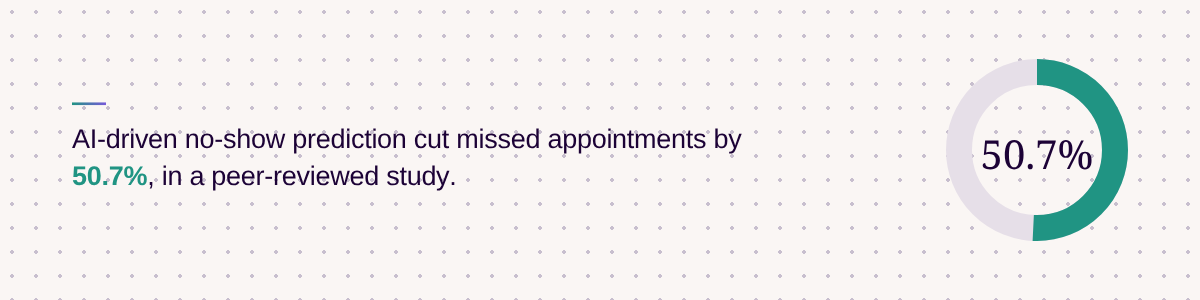
· AI-driven no-show prediction cut missed appointments by 50.7%, in a peer-reviewed study.
One reminder, sent the same way to every patient, treats someone with a string of missed visits exactly like someone who never misses. Outreach that reflects each patient's history, reaches them on the channel they actually answer and lets them confirm or reschedule in the thread puts the effort where the risk is. Our guide to proactive outbound communications covers what that takes.
Watch an AI agent book the appointment
SpinSci's digital workforce of AI agents books, confirms and reschedules appointments inside the EHR, and sends reminders patients can answer in the same thread. SpinSci serves 165 health systems, with 400 million plus patient interactions supported annually. Book a demo here.
Sources
grandviewresearch.com | technavio.com | pmc.ncbi.nlm.nih.gov
See how a digital workforce changes patient access at your health system.
.svg)
%20(29)%20(1).avif)


%20(41)%20(1).avif)
.svg)