




%20(1).png)
Conversational AI in healthcare is technology that understands and responds to patients in natural language, by voice or text. It makes interactions easier for patients, but on its own it can only discuss a request. Resolving that request requires AI agents connected to the health system’s data, workflows, and operational rules.
If your health system is looking for ways to improve patient access while managing growing demand, conversational AI is likely on your list. This guide explains how it works, how it compares to chatbots and IVR, where it falls short on its own, and what it takes to move from understanding a patient’s request to resolving it.
How Does Conversational AI Work in Healthcare?
Conversational AI lets your patients communicate with your health system in their own words instead of navigating rigid menus or searching for information themselves.
The AI interprets what the patient needs and determines how to respond. Depending on the technology and workflow, it may provide information, access relevant patient or operational data, or take action on the patient's behalf.
What happens next depends on what the technology can reach. A patient might say, “I need to move my appointment.” Conversational AI on its own can understand the request and explain how to reschedule. Completing the reschedule requires access to the patient’s appointment information, available openings, and the health system’s scheduling rules.
How Is Conversational AI Different From Chatbots and IVR?
A chatbot is one form of conversational AI. Most chatbots work through a text interface on a website, patient portal, or app, and they are typically designed to answer common questions or point patients to the right resource. Text works well for simple requests, but speaking is often a more natural way to communicate, particularly when a patient is explaining something that doesn’t fit neatly into a form.
Traditional interactive voice response (IVR) systems work differently. They rely on predefined menus and commands. Patients select options, enter information, and follow a prescribed path to reach the right destination.
Voice AI changes that experience by allowing patients to simply speak what they need. Instead of figuring out which menu option fits, a patient can explain the situation in their own words and let the AI interpret the intent.
That makes access easier for patients who prefer speaking to typing, navigating an app, or remembering which option to select. Not every patient interacts with technology in the same way, and for many patients, including older adults, picking up the phone and explaining what they need remains the most natural approach.
Chatbots and Voice AI both improve how patients describe what they need. What happens after the request is understood depends on what the technology behind them can access, and that is where conversational AI on its own runs into limits.
Where Conversational AI Falls Short
Conversational AI solves one problem well: it lets patients explain what they need without navigating menus or forms. The limitation shows up after the patient finishes speaking. If the technology can’t access the patient’s appointment, referral, or account information, it can only explain the next step or transfer the call. Your staff still pick up the work, and the patient often repeats the same details to a second person.
The same gap appears across patient access. A patient calling about a referral may have to explain the situation again while someone searches for its status. A patient who wants to reschedule may get instructions instead of a new appointment. The interaction is easier for the patient, but the request itself hasn’t moved forward. We explore this gap in more detail in Why Healthcare Must Move Beyond Conversational AI.
What Is the Difference Between Conversational AI and Agentic AI?
Conversational AI is the way a patient interacts with the system. Agentic AI is the approach that acts on the request once it’s understood, carried out by AI agents. An AI agent can confirm who the patient is, check the relevant systems, apply the health system’s scheduling and routing rules, and complete the task or bring in a staff member with full context. Conversational AI remains part of that experience, since it’s how patients talk to the agent. The difference is that the interaction ends with the request resolved rather than handed off.
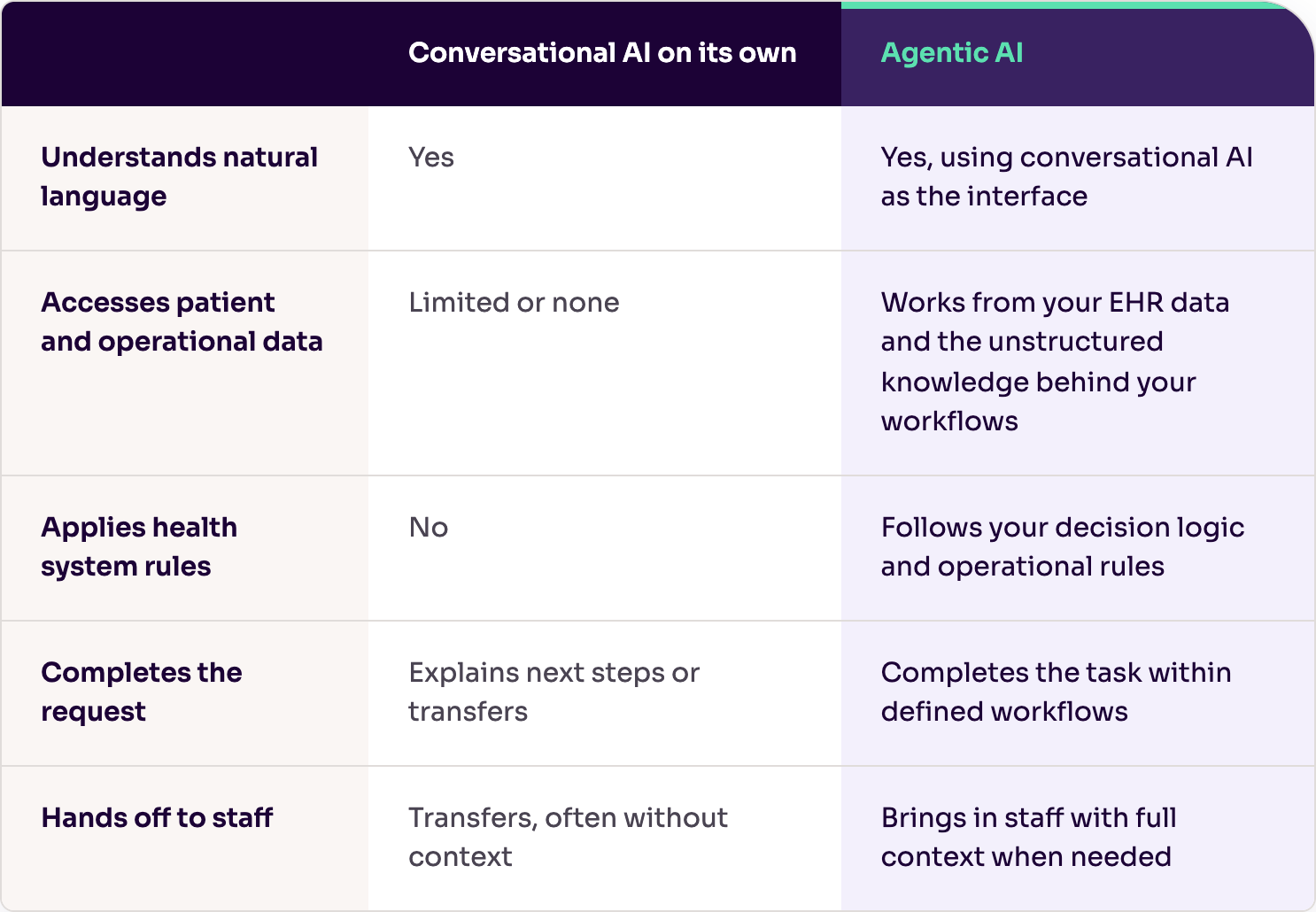
Consider a patient who asks, “Where do I go for my MRI tomorrow?” Conversational AI that isn’t connected to the patient’s appointment information won’t know the answer, so it directs the patient elsewhere or transfers the call. An AI agent can look up the appointment, identify the correct location and instructions, and offer to text the patient a link with directions.
For your health system, that difference means fewer transfers and less repetitive work for staff, while patients get a more direct path to what they need.
What AI Agents Need to Resolve Patient Requests
Connecting an AI agent to your EHR gives it access to data. It doesn’t give the agent the knowledge to act on that data the way your health system would. Much of what determines how a request should be handled lives outside structured fields: scheduling protocols, provider preferences, referral rules, department policies, and the know-how your staff have built up over years. That knowledge is often unstructured and scattered across documents, spreadsheets, call scripts, and people’s heads.
To resolve requests the way your staff would, AI agents need a mechanism that does three things: extracts the decision logic already designed into your EHR, turns the unstructured knowledge your health system runs on every day into something AI agents can reason with, and orchestrates each workflow according to your health system’s own operational rules. SpinSci’s Healthcare AI Fabric (HCAF) is built to do exactly that. With HCAF beneath them, AI agents understand not only what the patient needs but how your organization handles it.
HCAF also carries context from one interaction to the next. A patient’s journey spans scheduling, referrals, reminders, and follow-up, often across voice and text. When every AI agent works from HCAF, your patients don’t repeat themselves, and agents know what should happen next, including when to reach out proactively. That is what makes a modern patient access experience with AI possible.
What Should You Look for in Conversational AI?
Understanding natural language is the baseline. The questions that separate one solution from another are about what happens after the patient speaks:
- Can it understand healthcare-specific intent and context?
- Does it run on a foundation that turns your EHR logic and unstructured knowledge into something AI agents can act on?
- Can it take action within established workflows?
- Can it maintain context throughout the interaction?
- Can it resolve appropriate requests rather than simply route them?
- Can it involve a human when needed with the relevant context?
Judge any solution by what it resolves for your patients and staff, not by how natural the conversation sounds.
Where Patient Access Is Heading
Your patients already expect to describe what they need in their own words, and conversational AI meets that expectation. What it doesn’t do on its own is book the appointment, find the referral, or answer the question about tomorrow’s MRI. That work still lands on your staff, and every request that stalls adds to the queue or ends with a patient who hangs up or books somewhere else.
Agentic AI closes that gap. When AI agents can reach your systems and follow your operational rules, they resolve routine requests around the clock and at any volume, and your staff can focus on the patients who need a person.
Want to see how AI agents resolve patient requests from start to finish? See how HCAF works.
See how a digital workforce changes patient access at your health system.
%20(38)%20(1).avif)
.svg)
.svg)
%20(41)%20(1).avif)