Agentic AI Healthcare Trends for 2027: What Health System Leaders Should Plan For

October 15, 2026

5 min read

Agentic AI is moving out of pilots and into health system operating budgets. This article walks CIOs and patient access leaders through seven shifts shaping 2027, from end-to-end workflows to data readiness and governance, and shows where to put the first enterprise-scale deployment.
Key Agentic AI Healthcare Trends
1. Agentic AI has moved into operating budgets. Most health care technology leaders are funding or building it, so the 2027 decision is where it goes first and what it runs on.
2. Judge agentic AI by completed workflows. Count the requests resolved end to end, not the callers moved out of a queue.
3. Patient access is the place to start at enterprise scale: high volume, defined rules, mature systems, and no clinical judgment asked of the AI.
4. Patient outreach is turning proactive: triggered by EHR events, two-way, and resolved in the same thread instead of creating another inbound call.
5. AI agents that share one context layer build on each other. A patchwork of point solutions leaves gaps that staff and patients have to fill.
6. Pilots reach production when the health system's data and decision logic are made AI-ready first.
7. Guardrails built into the architecture (permissioned tools, audit trails, escalation with full context) are what let AI agents work autonomously.
What Is Agentic AI in Healthcare?
Agentic AI plans and carries out multi-step work toward an outcome, where generative AI answers a prompt or helps with a single task. In a health system, that means AI agents that act inside the EHR and the contact center platform and finish the work alongside staff. The seven agentic AI healthcare trends below show what separates the health systems scaling it from those still testing it, and what each one means for 2027 planning.
1. Agentic AI Moves From Pilot Projects to Operating Budgets
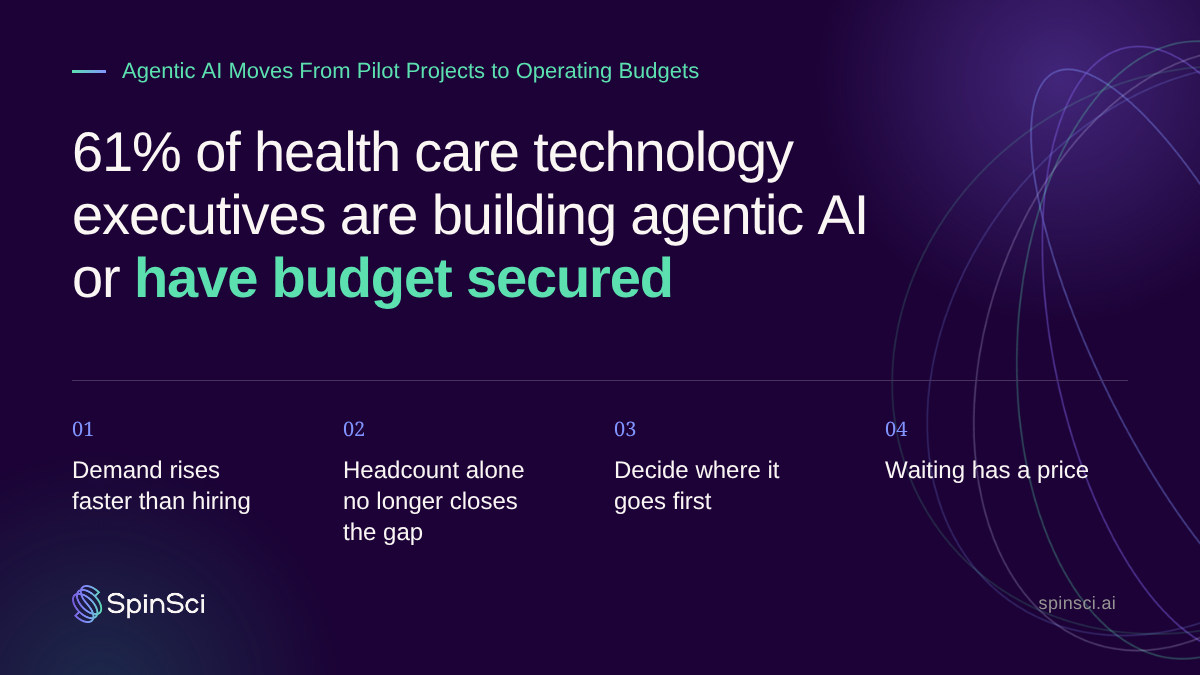
The money has moved. According to Deloitte, 61% of the health care technology executives it surveyed are already building agentic AI initiatives or have secured budget, and 85% plan to spend more on it over the next two to three years.
The pressure behind those budgets is familiar. Patient demand keeps rising, access teams cannot hire fast enough to meet it, and the cost of staffing grows faster than the money set aside for it. Headcount alone no longer closes the gap.
For a CIO, the 2027 question is no longer whether to fund agentic AI. It is where it goes first and what it runs on. Waiting has a price. Health systems that start now turn early capacity gains into the next round of investment, and the gap is already showing: Deloitte found that 59% of early adopters expect cost savings above 20% in the next two to three years, compared with 13% of organizations still watching.
2. The Shift From Single Tasks to End-to-End Resolution
Patients do not call to complete a step. They call to get an appointment, a refill, or a bill settled. Earlier automation handled one step and handed the rest to staff. A phone menu routed the call. A conversational front end understood the request and transferred it anyway. The task stayed unfinished and the queue stayed full.
Agentic AI handles the whole workflow. A patient calls with a cardiology referral. The AI agent verifies identity, confirms the referral is active, applies the health system's own scheduling rules, books the consult and the test that has to follow it, writes both to the EHR, and sends the confirmation. One call, no transfer, no callback.
The metric changes with it. Deflection counts callers moved out of the queue. True containment counts requests resolved end to end, and it is the number that turns into staff capacity. This is the move beyond conversational AI. When a request falls outside the rules, the AI agent hands it to staff with full context, so the exception moves faster too.
3. The Next Wave Targets Administrative and Patient Access Work
Agentic AI is being applied across healthcare: revenue cycle and claims work, clinical documentation, patient monitoring, and patient access. These do not move at the same speed, and a CIO with a mandate to show results needs to know which one to back first.
Clinical productivity tools are the most widely adopted generative AI in care organizations today, and they assist a clinician with a single task rather than act on their own. For agentic AI, leaders in McKinsey's latest survey point to administrative efficiency as the largest opportunity, and contact center and access work is rated high in potential while still less widely implemented.
That is where to put the first enterprise-scale deployment. Operational AI is faster to deploy and easier to govern than clinical AI, which carries a longer regulatory path, a distinction covered in what CIOs need to know about AI agents. In patient access the volume is high, the rules are defined, and the systems it connects to are mature. The boundary is clear too. AI agents book care, process requests, and route anything urgent to clinical staff at once. They do not interpret symptoms or give clinical advice.
4. Patient Outreach Turns From Reactive to Proactive
Most health systems already reach out to patients about appointments, referrals, and refills. The problem is how. One-way texts tell the patient what to do but still require a phone call to do it, which sends the work right back to the contact center. Manual call-downs from a worklist are slow, eat up staff hours, and often end in voicemail. Either way, no-shows, lapsed refills, and referrals that go cold keep piling up.
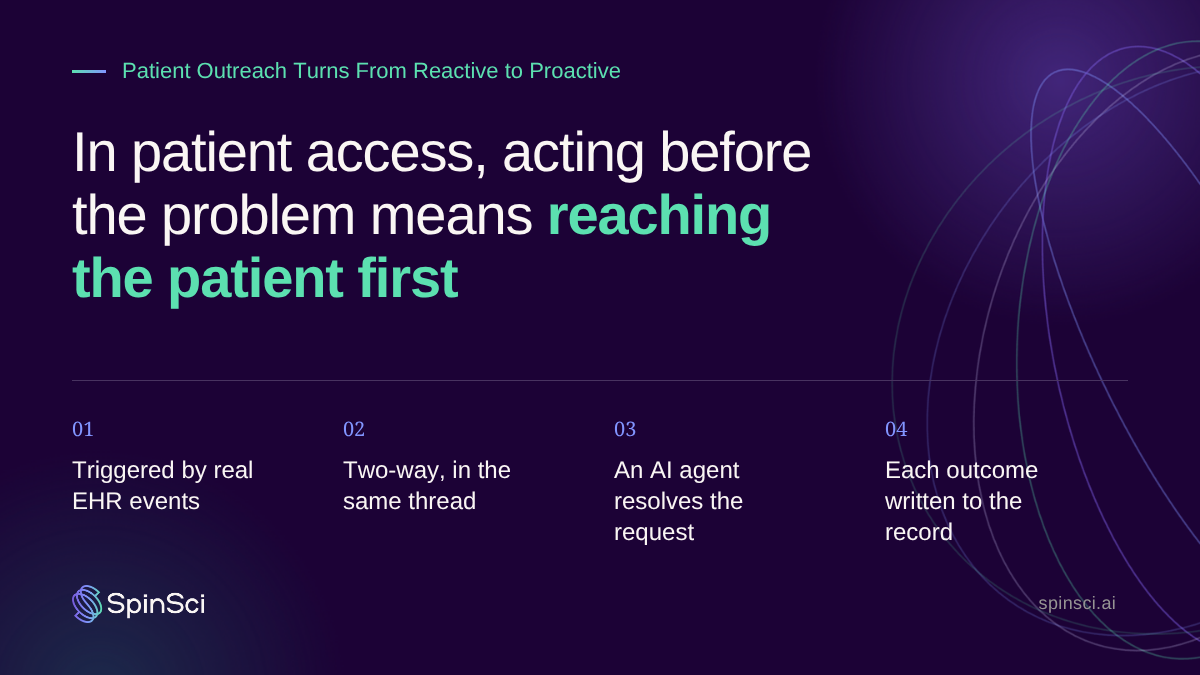
Proactive outreach works differently. It starts from events in the EHR, such as a new referral or an upcoming appointment, not from a list someone has to work through. It is two-way. The patient can confirm, reschedule, or ask a question in the same thread. An AI agent handles that conversation and resolves routine requests on the spot. Anything that needs a person goes to staff with the context already attached, so the reminder doesn’t turn into one more inbound call. Each outcome is written back to the EHR, so the next step starts from what actually happened.
A large Arizona health system replaced manual referral follow-up calls with EHR-triggered outreach. As its Enterprise Senior Manager put it: “Patients hear from us automatically, and our team is focused on the conversations that actually need a human.”
5. Coordinated AI Agents Beat Point Solutions
Many health system CIOs already manage a patchwork: a scheduling tool, a reminder service, an agent assist product, each bought to solve one slice of patient access. A Deloitte survey of 100 US health system and health plan technology executives shows the split is already visible. Among organizations already implementing agentic AI, 82% are prioritizing multi-agent solutions. Among those waiting for more evidence before investing, 92% prefer point solutions.
Point solutions stall for structural reasons. Each one needs its own integration with the EHR and the contact center platform. Each keeps its own copy of the rules. None of them knows what the others told the patient. Deloitte makes a similar point: point solutions can improve efficiency in individual tasks, but they often don’t redesign the workflow from end to end.
Coordinated AI agents work from shared context, so each one builds on what the others did. The AI agent that schedules knows what the outreach message said. The staff member who takes an escalation sees both, without asking the patient to repeat anything. At one large US health system, self-service, real-time support for staff, and proactive outreach all run on a single EHR-integrated platform. Its IT leadership describes the result: “Bringing together self-service, real-time patient context, and proactive outreach has helped us create a more connected and efficient experience for both patients and staff.”
For the CIO, this means consolidation as well as new capability: fewer systems to integrate, secure, and maintain.
6. Data Readiness Decides Which Pilots Reach Production
Far more organizations are testing agentic AI than running it. In McKinsey's Q4 2025 survey of US healthcare leaders, 19% said their organizations have implemented agentic AI, while another 51% are pursuing proofs of concept. Turning those proofs of concept into production is the work of 2027.
What holds them back is rarely the model. It is fitting AI into the systems and workflows already in place. The rules an AI agent needs live in EHR decision trees, and in the PDFs, spreadsheets, and staff memory that legacy systems cannot reach. A pilot runs on clean, hand-picked data. Production does not.
Closing the gap takes a mechanism, not a bigger model: extract and operationalize the decision logic in the EHR, ingest structured and unstructured data, and convert static logic into an intelligence layer AI can reason over. That is the job of SpinSci's Healthcare AI Fabric (HCAF), the layer under every SpinSci AI agent. It is also why healthcare AI fails without data readiness.
The question to put to any vendor: what happens to our data and our rules before the model ever sees them?
7. Governance Becomes Architecture, Not a Policy Layer
Risk can end an AI project faster than cost. Accuracy, security, and compliance stay near the top of every leader's list, and a CIO is right to hold the line on them.
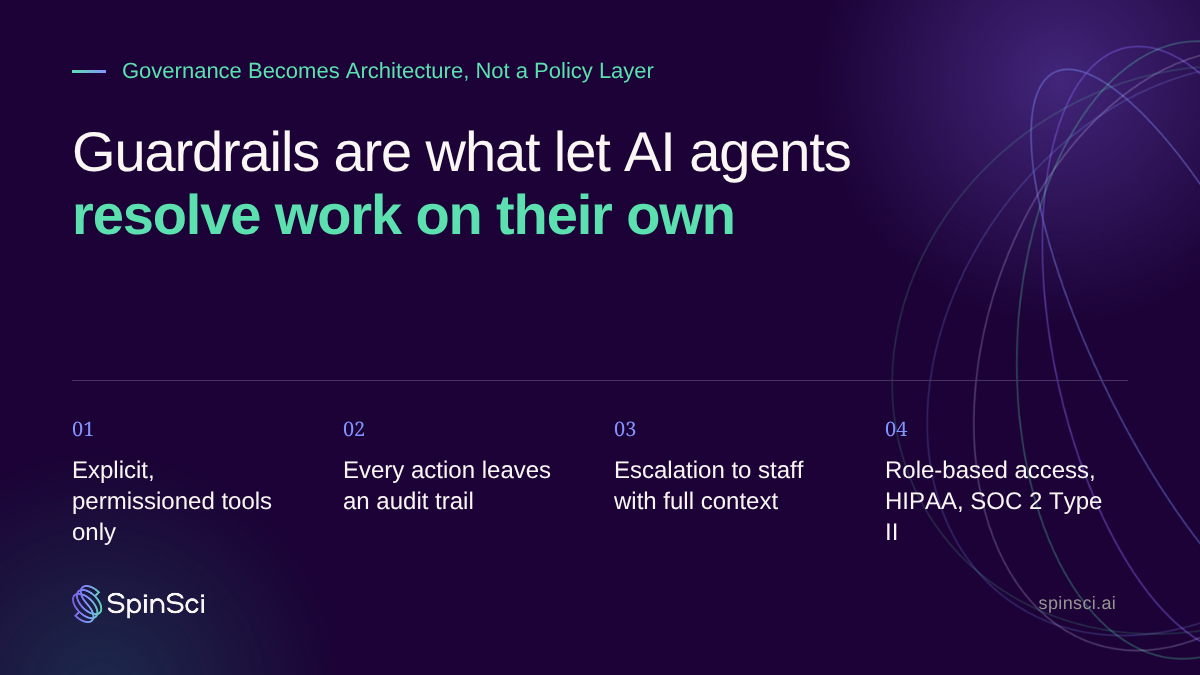
The answer is structural, not a policy document. AI agents act only through explicit, permissioned tools. They offer only what the system of record returns, so no appointment slot or balance is invented. Every action leaves an audit trail.
Escalation is designed in. Anything outside the rules, anything urgent, and any patient who asks for a person goes to staff with full context attached.
This is what lets autonomy scale. Guardrails are the reason AI agents can be trusted to resolve work on their own. For 2027, contracts require role-based access, review before any workflow change goes live, full audit and reporting, HIPAA compliance backed by a signed business associate agreement, and a current SOC 2 Type II report. Governance is one of the tests in a buyer's framework for AI patient access platforms.
Frequently Asked Questions About Agentic AI in Healthcare
What is the difference between agentic AI and generative AI in healthcare?
Generative AI responds to a prompt or helps with one task, such as drafting a note. Agentic AI plans and completes a multi-step workflow toward an outcome, such as verifying a patient, applying scheduling rules, booking the appointment, and writing it to the EHR, and hands exceptions to staff with full context.
Where should a health system deploy agentic AI first?
Patient access is the strongest starting point for an enterprise-scale deployment. Call and message volume is high, the rules are defined, the EHR and contact center systems are mature, and the work does not require the AI to make clinical judgments.
Why do agentic AI pilots fail to reach production?
Most pilots stall on data and integration, not the model. Pilots run on clean, hand-picked data, while production depends on decision logic spread across EHR configuration, PDFs, spreadsheets, and staff knowledge. Making that logic AI-ready is what moves a pilot into production.
See Agentic AI Resolve a Patient Access Workflow
Each of these trends comes down to one thing you can verify: whether the work gets done. Book a demo for a short video call and watch SpinSci's digital workforce of AI agents take a patient access workflow from first contact to resolution. Bring the workflow that gives your team the most trouble.
See how a digital workforce changes patient access at your health system.