


Healthcare Call Center AI Statistics: 9 Numbers to Know

October 14, 2026

5 min read
%20(1).png)
Nine healthcare call center AI statistics for contact center and patient access leaders: how fast the market is growing, how many call centers report using AI, what patients say they will accept, and what SpinSci sees in its own deployments.
Key Healthcare Call Center AI Statistics
· The global healthcare call center AI market was valued at $241.7 million in 2024, and its growth is estimated at a 26.1% CAGR from 2024 to 2030.
· In a 2024 survey of healthcare call center leaders, only a quarter of call centers used AI to enhance self-service options, while another 40% were actively looking into AI.
· 68% of medical groups added or expanded AI tools in 2025 (up from 43% in 2024), and call-center/phone trees were among the common uses after clinical documentation.
· 67% of patients would rather have 24/7 help from an AI agent than wait for regular office hours.
· SpinSci's Voice AI achieves a 98% natural language success rate, and automating patient verification saved one SpinSci customer 40-50 seconds on average per interaction.
· SpinSci's Voice AI achieves a 98% natural language success rate, and Patient Assist saved one SpinSci customer 40-50 seconds on average per interaction by surfacing the right patient information, speeding up patient verification.
How big is the healthcare call center AI market?
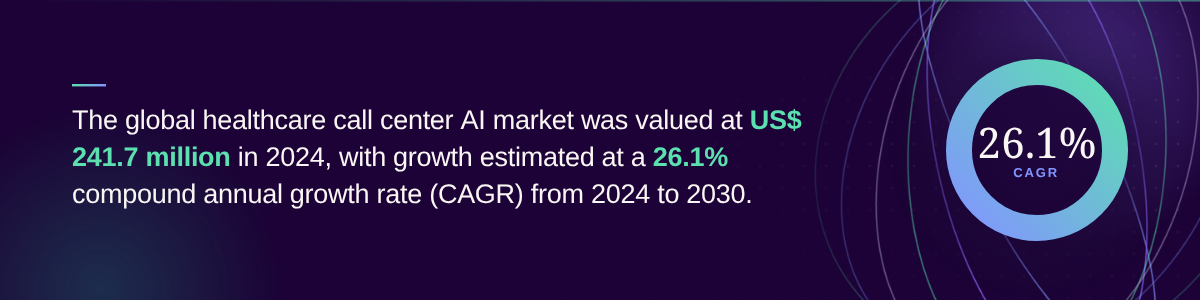
· The global healthcare call center AI market was valued at $241.7 million in 2024, with growth estimated at a 26.1% compound annual growth rate (CAGR) from 2024 to 2030, according to Grand View Research.
The spending follows the call volume. Demand rises faster than health systems can hire, train, and keep contact center staff, so budget is moving to the place where patient access is won or lost: the call itself.
How many healthcare call centers use AI?
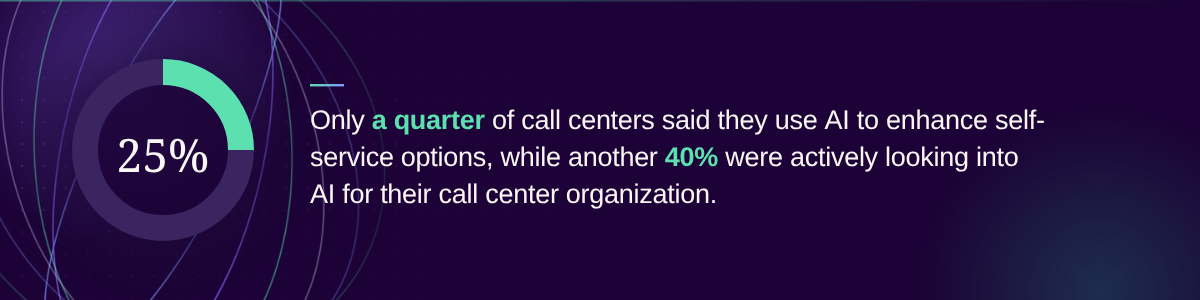
· Only a quarter of call centers said they use AI to enhance self-service options, while another 40% were actively looking into AI for their call center organization, in Healthcare Contact Center Times' 2024 industry survey of healthcare call center leaders.
· 68% of medical groups added or expanded AI tools in 2025 (up from 43% in 2024). After clinical documentation, the next most common uses clustered around scheduling and patient communications, including call-center/phone trees, according to a poll of medical group leaders.September 2025 MGMA Stat poll.
Interest is not the constraint. The phone tree is where most call center automation started, and where much of it stopped. A phone tree routes the call. It does not finish the request.
A system that understands what the patient wants and still hands the task to a person has not removed any work. The measure that counts is whether the request is resolved on the call, which is the standard behind SpinSci's guide to healthcare contact center automation.
Do patients want AI agents answering their calls?
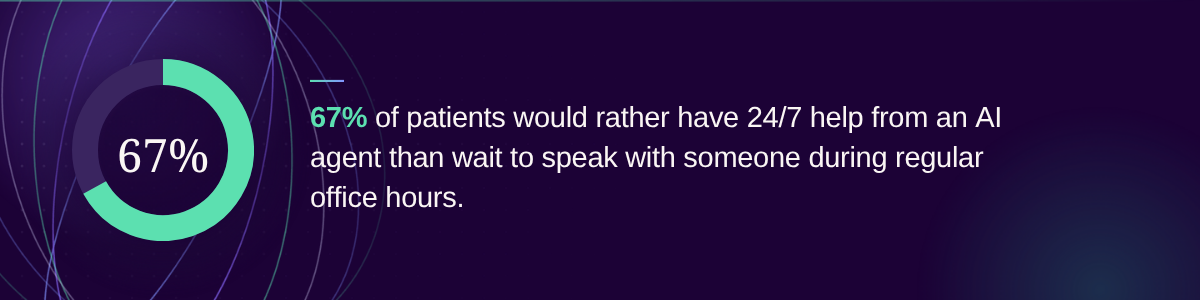
· 67% of patients would rather have 24/7 help from an AI agent than wait to speak with someone during regular office hours, according to a patient survey.
· More than 35% of consumers in Asia-Pacific reported being comfortable with AI-only call centers, in a survey of the region's healthcare consumers.
AI agents have no queue and no shift, so a call at midnight is answered like a call at noon. Patients judge that call by one thing: whether their request got done.
That does not make an AI-only call center the goal. The model that works pairs the two. AI agents resolve routine requests such as scheduling, refills, and billing questions end to end, and staff take the calls that need a person, with the full context of the conversation handed over.
What results does SpinSci see from AI in the contact center?
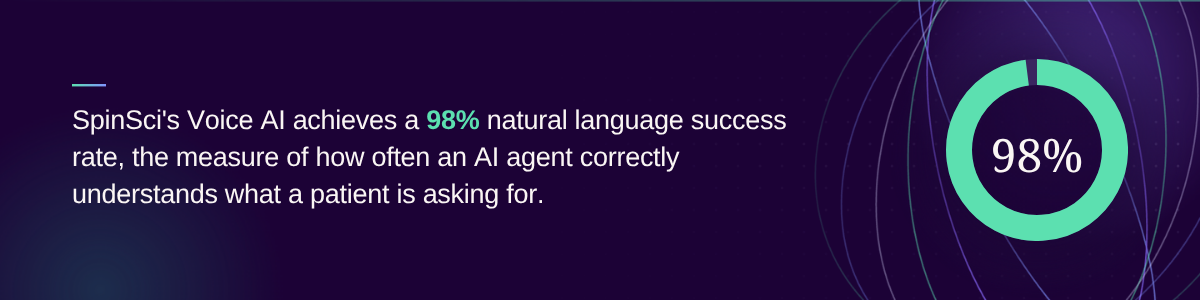
· SpinSci's Voice AI achieves a 98% natural language success rate, the measure of how often an AI agent correctly understands what a patient is asking for.
· SpinSci's Patient Assist (Contact Center AI) gives agents a 360-degree view of the patient record within a single desktop, helping them quickly access patient information, validate patient details, locate providers, and complete common service requests without jumping between systems. By putting the right information in front of agents when they need it, Patient Assist helps streamline common interactions and reduce call handling time. For one of SpinSci's health system customers, Patient Assist helped save an average of 40-50 seconds per interaction. "The value add there is a huge time savings across our volume of calls," says the organization's Director of Patient Accounts.
These are the two levels of AI in the contact center. AI agents resolve routine calls end to end, and the calls that do reach staff start with the patient's context already on screen. Both run on SpinSci's Healthcare AI Fabric (HCAF), the intelligence layer that connects natively to the EHR and the contact center platform.
See a patient call resolved end to end
SpinSci serves 165 health systems and supports 400 million plus patient interactions annually. Book a demo and watch an AI agent take a scheduling call from the first sentence to the confirmation, then see the same call handled as a human agent.
Sources
Grand View Research: Healthcare Call Center AI Market | Healthcare Contact Center Times: 2024 Industry Survey Report | MGMA Stat poll, September 2025 | Salesforce: 2026 Connected Health Consumer Report
See how a digital workforce changes patient access at your health system.
.svg)
%20(36)%20(1).avif)
.svg)
%20(58)%20(1).png)